 25 September 2026
 8 min read
 Worthing Auto Locksmith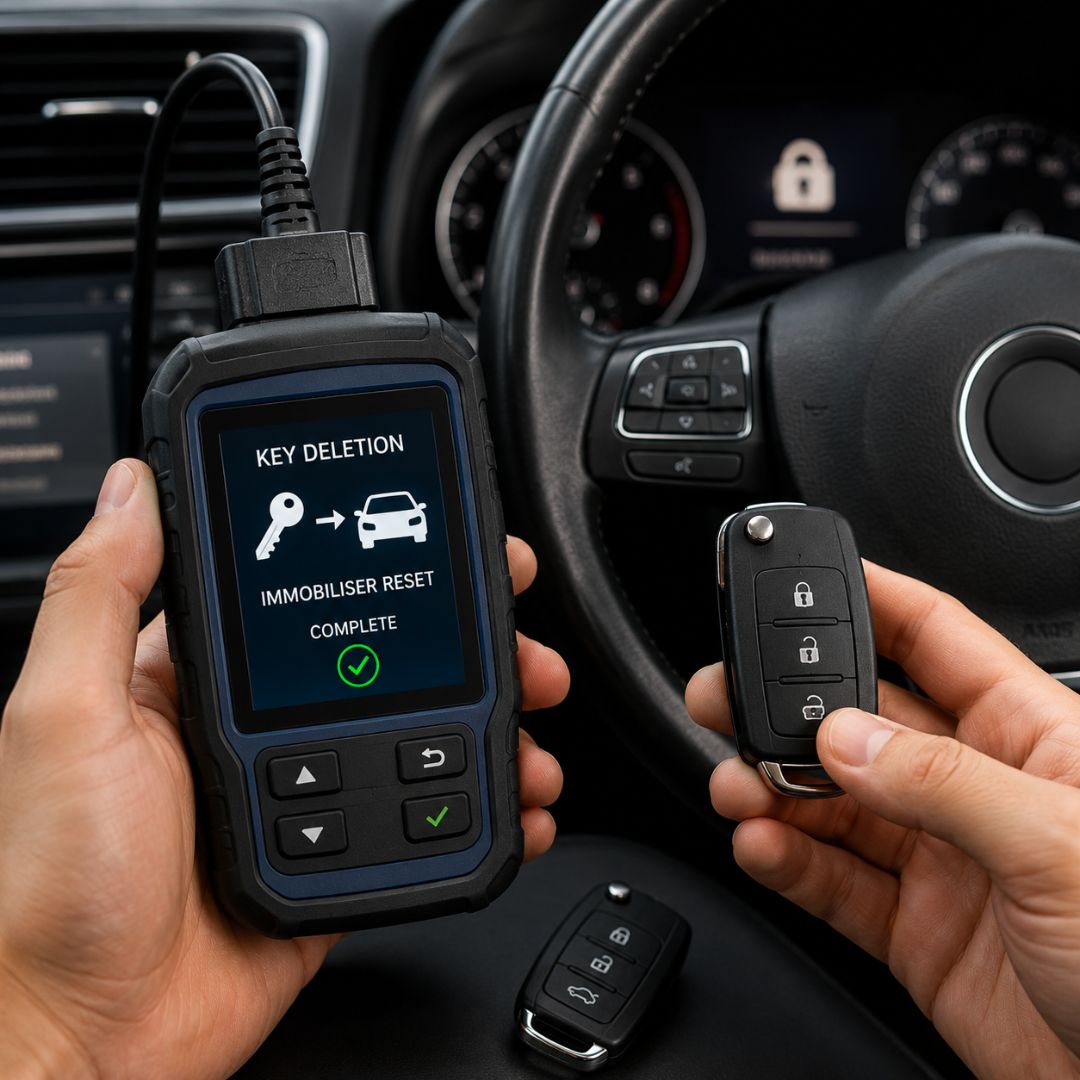
A flashing immobiliser light with an engine that turns but never fires almost always means the car cannot read the key. Nothing is mechanically wrong. The security system is withholding permission to start.
It is doing exactly what it was built to do, and that is worth knowing before anything else, because it moves the problem away from the engine and onto the link between the key and the car. Most of these faults sit in the key, and the free test further down this page splits the diagnosis in about ten seconds.
Why is the immobiliser light flashing and the car will not start?
The immobiliser holds the engine until it recognises an authorised key. When it cannot, the light on the dashboard reports that refusal. The starter still turns the engine over on most cars, and the engine sometimes catches for a second before dying, because fuel and spark are cut the moment the check fails.
The part being looked for is the transponder, a chip in the head of the key that answers a coded question from the car. Transponder key programming is what writes that answer into a key in the first place, and a key whose chip is no longer read produces this exact symptom.
Before reading any further, there is one test worth running. Try the spare key. If the car starts on it, the fault is in the first key and the vehicle is fine, which turns a recovery into a much smaller job.
Is a flashing immobiliser light always a fault?
No. A slow, steady blink with the car locked and the key out of the ignition is completely normal. It is the armed indicator, and on most cars it is deliberately visible through the windscreen as a deterrent.
The two cases look similar on a dashboard and mean opposite things.
- Key out, car locked, slow steady blink. Normal. The immobiliser is armed and the car is protected.
- Ignition on, light stays lit or flashes quickly, engine will not start. The car cannot read the key.
A light that has blinked away every night for years and only got noticed this morning is not the reason the car will not start today. The fault case only applies with the ignition on.
What does the immobiliser do when you turn the key?
The immobiliser is the electronic system that withholds permission to start unless it recognises an authorised key. It is the reason a modern car cannot be started by force the way an older one could.
Three parts do that job, and they fail in roughly this order.
- The transponder inside the key, which holds a coded identity
- The reader, a coil around the ignition barrel or an aerial behind the dash, which asks the question
- The module in the car, which holds the codes it is prepared to accept
Break any one of the three and the car behaves identically from the driving seat. That is the whole difficulty with this fault. The symptom never identifies the part on its own, which is why the checks below start with the cheapest thing to rule out rather than the most likely.
Manufacturers give this system different names, so the same fault is described in different words depending on the badge on the bonnet.
What stops the car from reading the key?
Seven things account for almost every flashing immobiliser light. The table below sets each one against what you actually notice and which trade puts it right.
| Cause | What you notice | Whose job |
|---|---|---|
| Flat or weak key battery | Remote buttons work weakly or not at all, and the key works only when held closer than usual | The key |
| Damaged or worn transponder | One key fails and the spare works normally | The key |
| Key never programmed, or erased | A newly cut or second-hand key opens the doors and will not start the engine | The key |
| Failed reader coil or aerial | Neither key works, and both were fine yesterday | The car |
| Low vehicle battery voltage | Dash lights dim or flicker as the key turns, worse after a cold night | The car |
| Wiring or module fault | Other electrics misbehave too, or the fault followed water getting in | The car |
| Aftermarket electrics fitted badly | The fault started immediately after a tracker, alarm or stereo went in | Either |
One thing worth separating out. The immobiliser light is not the engine management light. A flashing engine light with a running engine points at misfiring rather than security, and it is a different problem with a different trade behind it. The immobiliser light usually looks like a key, a car with a padlock, or a car with a key inside it, and a key that has physically come apart is covered by car key fob repairs rather than by anything on the vehicle.
Which checks can you make before calling anyone?
Four checks are worth making before anyone is called out. All four are free, all four are safe, and between them they rule out most of the table above.
The spare key check is the one that matters most, and it is also the reason a car with only one key is a problem waiting to happen. Spare car keys are cheapest to make while the original still works, and on a morning like this one they are the difference between a ten second test and a recovery truck.
Can a flat battery cause an immobiliser light?
Yes, and it is the most common cause of all. The module and the reader both need steady voltage to do their job, and a battery that reads normally at rest can still collapse under the load of cranking.
The tell is in the dashboard. Lights that dim or flicker as the key turns, a car that was fine yesterday and dead after a cold night, or a starter that sounds slower than usual all point at voltage rather than security. A jump start that cures it answers the question outright, and one that changes nothing has ruled out the cheapest explanation without costing anything.
What does resetting an immobiliser actually mean?
There is no consumer reset button on a modern car. What the trade calls a reset is almost always one of two specific operations, and knowing which one is needed is most of the job.
Reprogramming writes a key into the car so the car accepts it. That is the answer when a key is no longer read, or when a newly cut key has never been introduced to the vehicle.
Erasing removes keys the car still recognises. That is the answer when a key has gone missing, when a used car came with fewer keys than it was taught, or after a theft attempt. An immobiliser reset is that operation, carried out against the vehicle records at the car.
Both are done with equipment, at the vehicle, against its own stored data. Neither is a sequence of ignition turns. The videos promising one belong to a small number of older models and do nothing at all on most cars built in the last fifteen years.
Is the fault in the key or in the car?
The key side. The spare works, or the fault followed one particular key, or the key has been dropped, washed or left in a pocket through a cycle. The car reads one key and not the other. These are the majority of flashing light no-starts, they are resolved at the vehicle in one visit, and car key programming is usually the whole of the fix.
The car side. Neither key works, the light behaves identically with every key, the fault appeared after electrical work or water reached somewhere it was never meant to, or other modules are misbehaving too. That is an auto electrician or a vehicle specialist rather than a key job, and saying so is more useful than sending a van.
Which side it sits on is established on the phone, from what the car actually does, before anyone sets off. Nobody pays for a visit that was never going to fix the problem.
Does removing the immobiliser fix the problem?
Removing or disabling the immobiliser does stop the light and does start the car. It does that by taking away the theft protection built into the vehicle, which makes it a removal rather than a repair.
The consequences are worth weighing honestly. The car loses the security system it was built with and becomes markedly easier to steal. It is also a modification worth checking against your own insurance policy wording rather than assuming, because factory security is part of what a vehicle was rated on.
For most readers the question is academic. On the large majority of these faults the problem sits in the key, and the key side is repairable for a fraction of what the alternative costs in security.
What to do right now if the car will not start
Four steps, in this order, turn a dead car into a job somebody can quote on.
A key-side fault is cut, coded and tested at the vehicle in one visit, at whatever hour the car decided to do this, because 24 hour emergency auto locksmith cover runs every day of the year.

 07932805727