 25 September 2026
 9 min read
 Worthing Auto Locksmith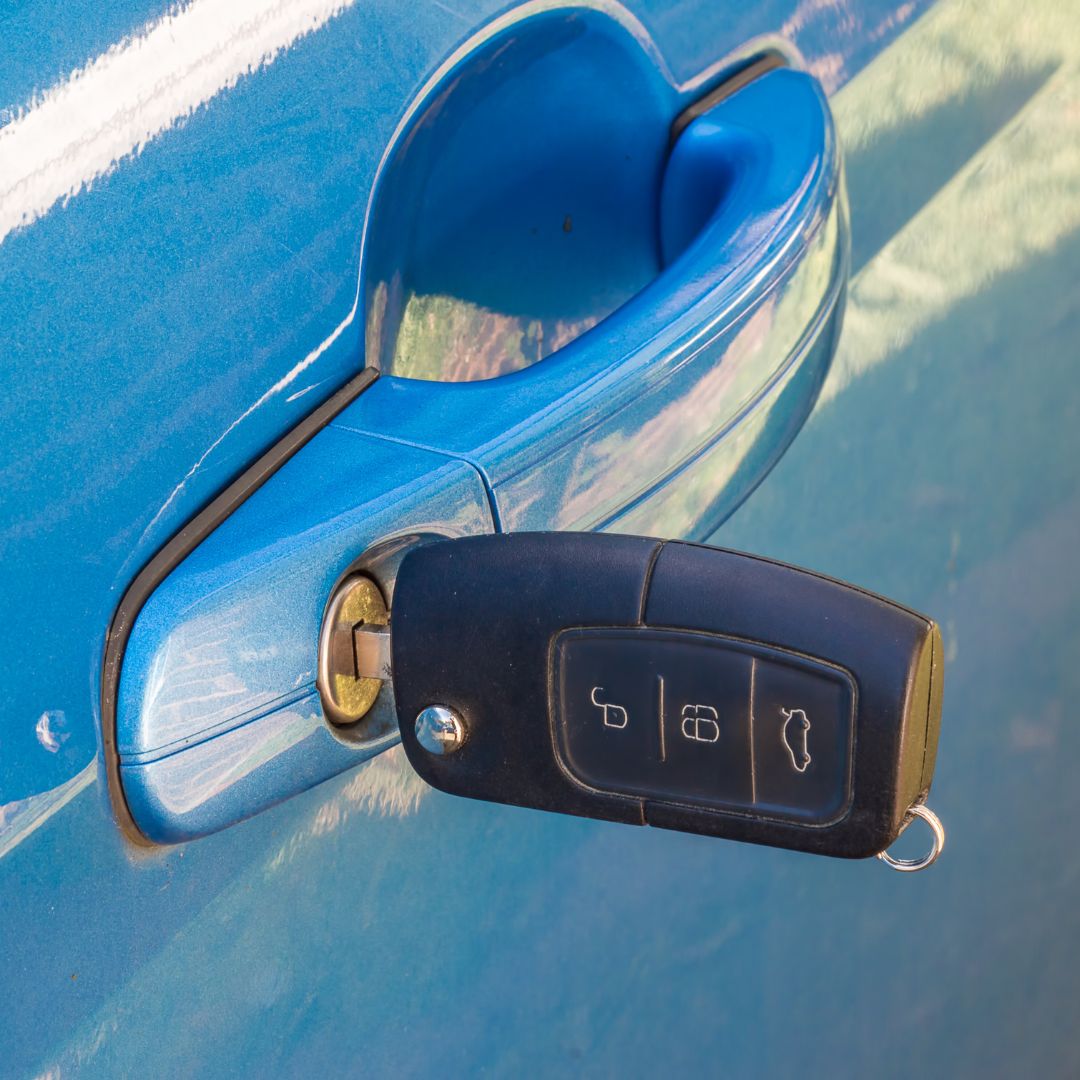
A relay attack uses a device to fool a car into thinking its key is nearby. It works only while somebody is within a few metres of the real key, through a wall. A signal blocking pouch stops it.
That is the whole defence in one sentence, and the rest of this is the detail behind it. How likely it actually is in Worthing, which cars it applies to, what the law changed in 2026, and which of the precautions people repeat are worth anything.
What a relay attack actually is
A relay attack is a way of extending the conversation between a keyless car and its key over a longer distance than either was designed for.
A keyless car is constantly listening for its key. When somebody touches the door handle the car calls out, the key answers, and the car unlocks. The whole exchange is meant to work across a couple of metres, and the car has no way of knowing how far away the key really is. It only knows that the right key answered.
A relay attack takes advantage of exactly that. Two people work together, one standing near the house and one standing at the car, and the signal is carried between them. The car hears an answer it accepts and opens, and because the same system authorises starting, it starts too.
What makes it hard to spot afterwards is that nothing is broken. No glass, no forced lock, no damage of any kind. The car is simply gone, and the keys are still on the hall table where they were left.
How common is this in Worthing?
Less common than the coverage suggests, and the honest numbers are worth having before anybody spends money on this.
Worthing recorded 351 vehicle crimes in the twelve months to April 2026, a rate of 2.85 for every thousand people. That is roughly two thirds of the national average. Across West Sussex the rate is lower still at 2.57, and the South East as a whole sits higher than both at 3.22.
So this is not a town with a vehicle crime problem, and anybody telling you otherwise is selling something. The precaution is still worth taking, and the reason is in the national picture rather than the local one.
Nearly 122,000 vehicles were reported stolen in England and Wales between April 2024 and March 2025, and in more than 92,000 of those cases no suspect was ever identified. Roughly three quarters of vehicle thefts end with nobody found. In one force area the police estimate electronic devices are involved in around 60 per cent of them.
Those two figures together are the argument. A car taken this way is very unlikely to come back and very unlikely to result in anybody being caught, which puts the entire weight on prevention.
Whether your car is at risk
Only some cars are, and the test takes a second.
If the car unlocks with the key still in your pocket and starts with a button, it has passive entry and it is in scope. If a key goes into a barrel and turns, it is not, whatever buttons the fob has on it. A smart key replacement is the kind of key this applies to, and most cars sold from around 2015 onwards have one on at least some trim levels.
Where the car sits overnight matters as much as what it is. A relay attack needs somebody standing close to the key, which in practice means close to the house.
- A car on a driveway, a few metres from the front door, is the highest risk arrangement there is, because the key is usually within range of the pavement
- A car parked on the street some distance from the house is harder, because the two people must stand further apart
- A car in a closed garage is hardest of all, and not mainly because of the signal
The same car, the same keys and the same habits produce very different risk depending on that one detail.
What the new law changed in 2026
The law on the equipment changed in 2026, and the change is larger than the headlines suggested.
The Crime and Policing Act 2026 created two new offences covering the possession, importation, making, adapting, supplying and offering to supply of an electronic device intended for use in vehicle theft. The maximum penalty is five years in prison, an unlimited fine, or both.
What actually changed is not the penalty, it is what has to be proved. Before the Act, this equipment was not illegal to hold. Somebody found with it could be charged with going equipped to commit theft under the Theft Act 1968, but a prosecution had to establish what the holder intended to do with it. Now possession is the offence in its own right.
For an owner that changes nothing about how the car is protected. What it changes is what happens when a vehicle is stopped and the equipment is found inside it, which is a meaningful shift in how these cases end.
What actually stops a relay attack
Three things work, and they are ranked here by how much difference each one makes for the effort involved. The first is the whole answer and the other two are what you do once it is done.
Signal blocking pouches and their limits
A signal blocking pouch is a fabric-lined bag that stops the key answering when the car is called. No answer means no unlock, which ends the attack before it starts.
Both keys need one. A key in a pouch and a spare in the kitchen drawer leaves the house exactly as open as it was before, and the spare is the one people forget. That applies to a set of spare car keys kept at home as much as to the everyday set.
Pouches wear out, and police guidance is to check yours every few months. The lining cracks along the fold and the seam gives up, and a pouch that has stopped working is worse than no pouch at all, because the owner has stopped thinking about where the keys are.
The test takes ten seconds. Put the key in, close it properly, and walk up to the car and pull the handle. If the car opens, the pouch has failed and it needs replacing.
Turning the signal off in the fob
Some fobs can be put to sleep, which does the same job as a pouch without the pouch. Whether yours can comes down to three cases.
Some fobs sleep on their own. Newer keys have a motion sensor and stop transmitting after a few minutes of sitting completely still. A key left on a hall table overnight is already dormant, and this is now common on cars built in the last few years.
Some have a button sequence. A combination of presses puts the key into a sleep mode until a button is pressed again. Where a car has this, the handbook gives the sequence for that model, and it is worth finding once rather than looking for it at bedtime.
Some have neither, which is most older keyless cars. For those, a pouch is the answer and there is no alternative to it.
Physical locks and where you park
A visible mechanical lock across the steering wheel sounds dated against an electronic crime, and it works for exactly that reason.
The whole appeal of a relay attack is that the car is away in under a minute with no noise and no damage. A lock that has to be cut off turns that into a long, loud job in the open, and the people doing this are choosing between cars rather than fixated on one. Nearly everything in vehicle security works this way. It is not about being impossible, it is about being more trouble than the car parked further down.
Where the car sleeps follows the same logic. A closed garage beats a driveway, a driveway beats the kerb, and a car behind another car is harder to take than one with a clear run at the road.
What does not stop a relay attack
Four things get repeated constantly and none of them is a plan.
- A biscuit tin or wrapping the key in foil. This sometimes works and cannot be relied on. The seal is the part that matters and a lid that does not close completely leaves a gap the signal gets through. A pouch costs very little and is designed for it
- The fridge or the microwave. Both are repeated as clever advice. Neither is built to block anything reliably, and a key living in a fridge gets damp and fails for a different reason
- Keeping keys upstairs and nothing else. Better than the hall table and still within range on a good many houses, particularly where the car sits on a drive directly below the bedroom window
- Assuming a newer car is safe. Manufacturers have improved this and some recent models genuinely resist it, but the improvement arrived model by model rather than year by year
When the keys were nowhere near
This is worth reading carefully, because it changes what happens next.
A relay attack needs somebody within a few metres of the real key. If the keys were upstairs in a pouch and the car has gone anyway, it was probably not a relay attack.
Two other routes account for most of the rest. A key can be produced at the vehicle itself by somebody with the right equipment, which is a different crime with a different defence. Or a key that already existed was used, which is the one people never think of, because a used car often comes with a history of keys nobody ever accounted for.
The second one has a straightforward answer. Every key a car will accept is stored in its immobiliser, and deleting keys from the immobiliser removes every key the car does not need, so only the keys in your hand will start it. Police guidance on buying a second hand car says to do this as a matter of course, and it is one of the few pieces of security advice that is a one-off rather than a habit.
How a locksmith closes the gap
Three things sit outside what an owner can do, and they are worth knowing about whether or not anything has happened yet.
Seeing how many keys the car holds. A car knows how many keys it will accept, and that number is readable. On a used car it is frequently higher than the number of keys that came with it, and nobody finds that out by looking at the keys.
Removing the ones that do not belong. Deleting unknown keys is quick and it is permanent. A key that has been deleted opens nothing, whoever is holding it.
Getting the car usable again afterwards. Where keys have been taken or deleted, a new one is cut and coded at the vehicle rather than the car going anywhere, and a 24 hour call-out covers the hours this tends to be discovered in.
None of that prevents a theft. What it does is close the gap left behind by one.
How to make yourself a poor target
Almost none of this is about being impossible to steal from. It is about being the less attractive car on the street.
Keys at the back of the house. Away from the front door, away from the letterbox, and not in the room the car is parked outside.
Both keys in pouches, tested twice a year. The spare matters as much as the one in daily use.
Something visible on the wheel. The point is that it can be seen from the pavement before anybody starts.
The drive rather than the kerb, and the garage rather than the drive. Where that is a choice, it is the cheapest security decision available. More on the wider picture in vehicle security across the town.
Change the pattern occasionally. Cars are watched before they are taken, and a car that is always in the same place at the same time is easier to plan around than one that is not.

 07932805727