 25 September 2026
 8 min read
 Worthing Auto Locksmith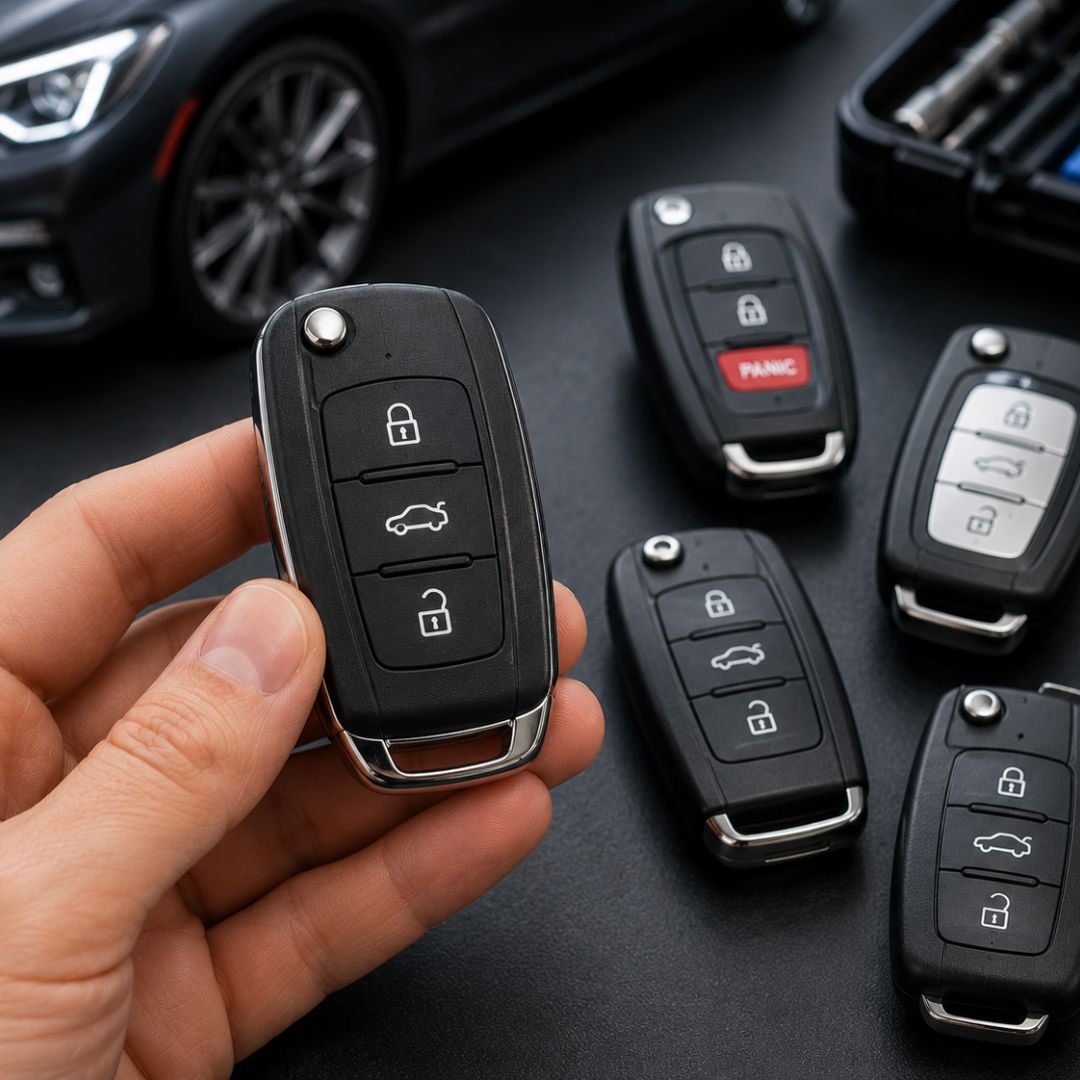
A transponder key carries a chip the car reads before it will start. A remote key adds buttons that lock and unlock from a distance. A smart key answers the car by itself, so it never leaves your pocket.
Almost every car on a British road uses one of those three, or a plain mechanical key on something older. Which one you have decides what a replacement involves, how long it takes and what it costs, so the first section below is about working out which one is in your hand.
Which key do you actually have?
Three questions settle it, and they take about ten seconds.
Does it have buttons? No buttons means a mechanical or a transponder key. Buttons mean a remote key of some kind, or a smart key.
What is the blade like? A rigid metal blade sticking out of a plastic head is a traditional shape, whether or not there is a chip inside. A blade that folds into the body at the press of a button is a flip key. A fob with no blade you ever use, or a thin blade hidden inside it, is a smart key.
How does the car start? This is the one that actually decides it. If the key goes into a barrel and turns, it is a mechanical, transponder or remote key. If you press a button on the dashboard while the key stays in your pocket, it is a smart key, whatever shape the fob is.
The last question overrides the other two. A smart key can look exactly like a remote key and behave completely differently, and that is the single commonest confusion on this subject.
The four types, side by side
The table sets the four types against what each one contains and what a replacement actually involves. The last column is the one that explains the price difference.
| Key type | Buttons | Chip inside | How it starts the car | What a replacement needs |
|---|---|---|---|---|
| Mechanical key | None | No | Turned in the barrel | Cutting only |
| Transponder key | None | Yes | Turned, and the chip read | Cutting and programming |
| Remote or flip key | Yes | Yes | Turned, and the chip read | Cutting, programming, remote paired |
| Smart or proximity key | Usually | Yes | A button, with the key detected in the cabin | Programming, and an emergency blade cut |
Most British drivers are in one of the middle two rows. Anything built from the late nineties to around 2015 is usually a transponder or a remote key, and anything newer with a start button is usually a smart key replacement when it goes wrong.
The top row has almost disappeared from the road, and the reason is a specific date.
Why 1998 divides every car key
There is a line running through this entire subject, and it is a date.
Immobilisers became compulsory on new cars sold in the United Kingdom on 1 October 1998. Germany had done the same nine months earlier and Finland the same year. Australia followed in 2001 and Canada in 2007.
Before that line, a car key was a piece of metal. The shape was the security, so anybody with a cutting machine and the pattern could produce one in two minutes. After it, a car key is metal plus data. The blade still has to fit, and the car also has to be told that this particular chip is allowed to start it.
That is why a key cannot simply be cut any more, and it is the honest answer to the question underneath most of these conversations.
It worked, which is worth saying. Applied across the fleet, immobilisers cut vehicle theft by around 40 per cent, and a study covering 1995 to 2008 found the value of the thefts prevented was at least three times what the devices cost to fit. The inconvenience of a key that has to be programmed is what that reduction is made of.
What a transponder key does
A transponder key looks like an ordinary key and contains a small chip in the plastic head, with no battery in it at all.
When the key goes into the barrel, an aerial ring around the barrel sends out a signal that powers the chip for a moment. The chip answers with a code, the car checks it against what it expects, and only then will the engine run. Turning the barrel without an accepted chip gets you a starter motor and nothing else, which is what killed hot-wiring as a way of taking a car.
It is the quiet layer underneath the other two. A remote key and most smart keys contain the same idea, which is why transponder key programming is part of almost every key job on a modern car. There is a fuller explanation of the chip itself in transponder keys explained.
What a remote or flip key adds
A remote key is a transponder key with a second, separate system bolted on top.
The chip still does the starting. The buttons do the locking, and they work in a completely different way. Pressing a button sends a short radio message to a receiver in the car, powered by a coin cell, using a code that changes every time so the same press cannot be recorded and replayed later.
Two systems in one shell is why they fail separately. A flat cell kills the buttons and leaves the car starting perfectly, because the chip needs no battery. A chip problem stops the engine while the doors still lock. People find that contradictory and it is simply two different things in the same piece of plastic.
A flip key, sometimes called a switchblade, is the same electronics in a folding shell. It is a shape rather than a technology, which is worth knowing because it is priced and replaced as whatever is inside it. Fobs supplied and programmed covers both shapes.
Why a smart key is different
This is the part that gets described wrongly almost everywhere, including by people selling them.
A remote key transmits when you press it. A smart key answers when the car calls it. That is the whole difference, and it is a reversal rather than an upgrade.
Aerials built into the door handles send out a low frequency signal at 125 kHz. A key close enough to hear it wakes up and replies on a much higher frequency, above 300 MHz. The car checks the answer and unlocks. Nothing was pressed and the key never left a pocket.
Starting works the same way with one addition. The car has to know the key is inside rather than standing next to the door, so it measures how strong the low frequency signal is where the key answers from. The interior field is tuned to stop about ten centimetres past the bodywork, which is why a smart key on the roof will not start the car and the same key on the passenger seat will.
Almost every smart key hides a thin mechanical blade inside it for the door lock, because a car that can only be opened electronically is unopenable when the cell dies. That blade still has to be cut, which is the part of a smart key replacement people do not expect.
Why the names are so confusing
Worth a short section, because the vocabulary is a genuine obstacle rather than pedantry.
The trade and the manufacturers between them use at least eight names for four things, and a reader given one word cannot find a page written with another.
- Transponder key, also chip key or immobiliser key
- Remote key, also key fob, remote fob, or remote head key where the buttons are built into a one-piece head
- Flip key, also switchblade key. The same electronics as a remote key in a folding shell
- Smart key, also proximity key, keyless entry fob, keyless go fob or push button start fob
Manufacturers add trade names of their own on top of all that, which is why two garages can describe the same key using four words between them. If you are quoting a key over the phone, the safest description is not a name at all. It is the registration, the year, and whether the car starts with a button or a turn.
What each type costs to replace
The table above ends with what a replacement needs, and that column is the price. It comes down to two things.
What has to be produced. A blade only, on a mechanical key. A blade and a chip, on a transponder key. A blade, a chip and a remote, on a remote key. A programmed fob and an emergency blade, on a smart key.
What has to be done at the car. Cutting is quick and the same on almost anything. Programming varies enormously by make and year, and on a smart key it usually takes longest because the fob, the immobiliser and the keyless system all must agree.
One case reverses the usual order and it surprises people. A smart key on a car that still has a working key can be cheaper and quicker than a plain transponder key on a car with no key at all. Having a working key matters more than the type does, which is the strongest argument for a spare there is. What a replacement costs sets out the bands by type.
Which type is most secure
There is no straight ranking, and any page that gives you one is simplifying.
Each generation closed the previous attack and opened a different one. The mechanical key was defeated by hot-wiring, so the transponder chip arrived and made the wiring irrelevant. Early remotes could be recorded and replayed, so rolling codes arrived and closed that.
Smart keys removed any requirement to touch the key, and in doing so they created a system that answers a call it cannot see the source of. That is the basis of the relay attack, which is covered properly under keyless car theft rather than here.
So the honest answer is that a well looked after key of any modern type, kept away from the front door and with a spare accounted for, is more secure than a poorly handled key of any other type. The habits matter more than the generation.
How to work out what yours needs
Four details settle what a car needs, and none of them is the name on the fob.
- The registration
- The year it was built, which sometimes differs from the plate
- Whether it starts with a button or with a key that turns
- Whether a working key still exists
The year matters more than the badge. The same model can use a transponder key in one year, a remote key two years later and a smart key after a facelift, and a key ordered against the badge alone is a key ordered against a guess.
Given those four, the type is settled before anybody sets off, and so is what the job involves. Car key replacement is quoted from the registration rather than from a description of the fob.

 07932805727