 25 September 2026
 8 min read
 Worthing Auto Locksmith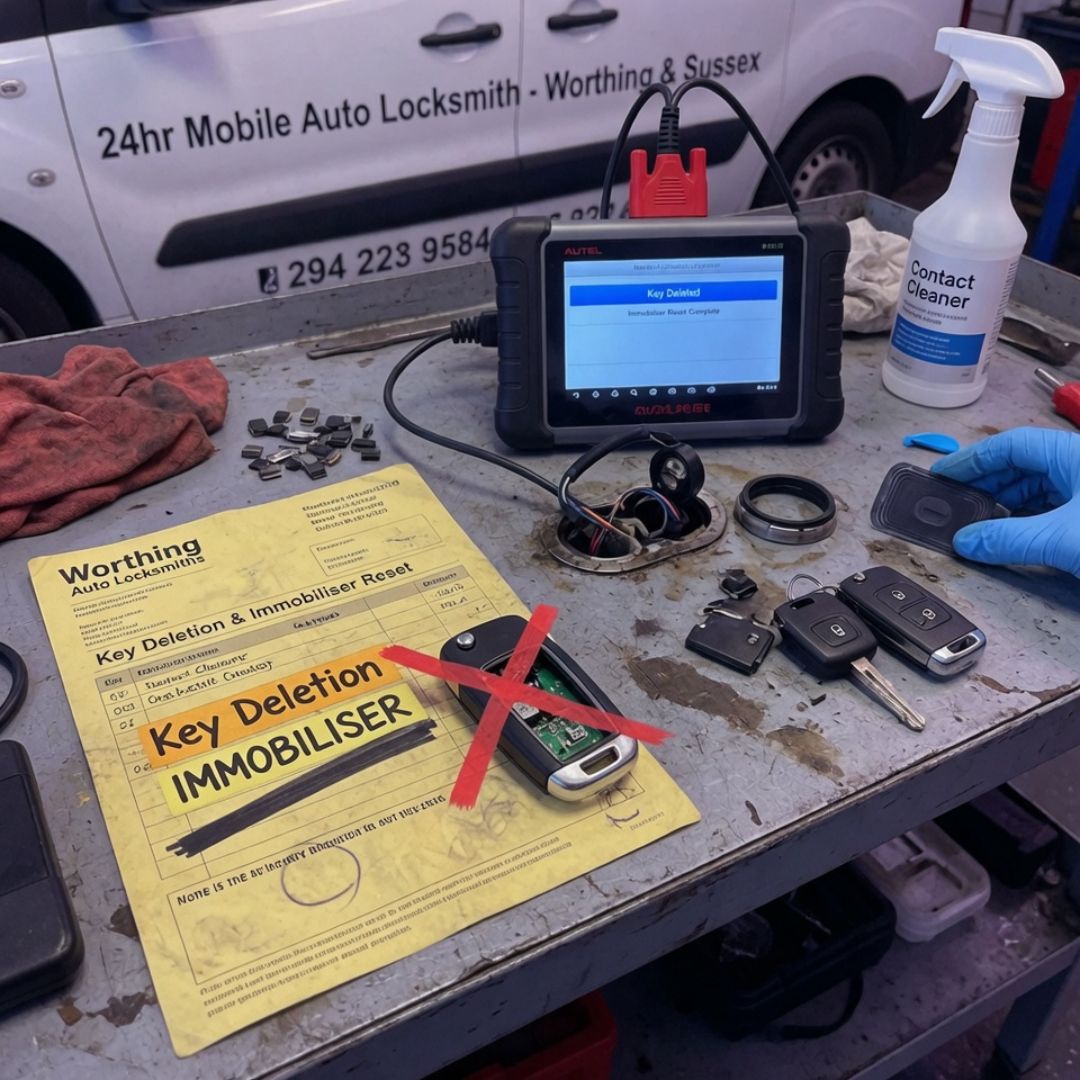
Car key programming writes a key into the immobiliser record of a vehicle so the car recognises it, through the OBD port under the dashboard. The blade opens the doors. The programming is what lets the engine start.
This guide covers what the port is, what actually travels over it during a key job, why some cars demand a security code first, and how long each version of the job takes at the vehicle.
How does car key programming work?
The first thing worth correcting is the direction of the operation. The car is programmed, not the key. A transponder key leaves the factory with a fixed identity built into it, and that identity never changes. What changes is the list of identities the vehicle is prepared to accept.
Three things take part. The transponder in the head of the key, which holds that identity. The immobiliser record inside the car, which holds the list. And the equipment that connects to the vehicle and adds one to the other. Car key programming is that third part, carried out at the vehicle rather than at a dealer.
One distinction is worth making early, because the two words are used as though they mean the same thing. Cloning copies an existing key so the car sees the same identity twice and never knows the difference. Programming adds a new identity to the record held by the car. Cloning suits some older vehicles. Programming is what modern cars require, and it is the only one of the two that can also remove a key.
What is the OBD port and what is it for?
The OBD port is a standard sixteen-pin socket fitted to every car sold in the UK since the early 2000s. On most vehicles it sits within reach of the driving seat, under the steering column, behind a flap in the footwell, or beside the bonnet release.
It was not put there for keys. It exists so that a technician can talk to the control modules in the car for diagnosis and emissions testing, which is why it is standardised across every make. Key programming borrows a road that was built for something else, and that single fact explains most of what follows on this page.
During a key job three things travel over it. A request to the module that holds the key records, an authorisation step that proves the request is allowed, and the write itself. The port is the doorway. The record being changed sits deeper inside the car.
What happens during an OBD key programming job?
Four stages take a key from a blank to a key that starts the car, and all four happen at the vehicle.
The writing stage is what people mean when they talk about transponder key programming. Everything either side of it is what makes that stage possible and what proves it worked.
Why do some cars need a PIN or security code?
A security code is a number held against the vehicle that the immobiliser demands before it accepts a new key. It exists for one reason. Plugging into the port is not, on its own, enough to add a key to a car belonging to somebody else.
Manufacturers introduced it as the port became universal, and it is the main thing standing between a standardised socket and an obvious weakness. Seen that way it is a security feature rather than an obstacle.
In legitimate work the code is held against the vehicle record and released through the proper channel to the person entitled to it. That is precisely why documents are checked before any equipment comes out of the van, and why proof of ownership is the first conversation rather than the last.
For the customer the practical effect is simple. A car that needs a code is a longer job, and occasionally a different route entirely.
What is the difference between adding a key and deleting one?
Adding puts a new identity onto the list the car accepts. Every key that worked before still works afterwards, and nothing already on the record is touched. This is the ordinary spare key job.
Deleting removes identities from that list. Any key holding one stops starting the car from that moment. This is what is done when a key has gone missing, after a theft attempt, or on a used car that turns out to recognise more keys than it was sold with. An immobiliser reset is that operation.
Here is the part worth remembering. They are separate operations and one does not imply the other. A replacement key cut after a loss leaves the missing key working until it is deleted. The new key solves the inconvenience. Only the deletion solves the risk.
How long does car key programming take?
Car key programming takes 15 to 30 minutes on an ordinary spare with a working key present. An all keys lost job takes 60 to 120 minutes, because the record is read and rebuilt rather than added to.
The table below sets the five usual jobs against the time each one takes at the vehicle and the thing that decides it.
| Job | Time at the vehicle | What decides it |
|---|---|---|
| Spare key, one key working | 15 to 30 minutes | Whether the system allows a straight add |
| Replacement remote or fob | 20 to 40 minutes | Whether the remote and the chip code separately |
| All keys lost | 60 to 120 minutes | Reading the record with nothing to copy |
| Vehicle requiring a security code | Add 20 to 45 minutes | How the code is released for that make |
| Deleting keys from the record | 20 to 40 minutes | How many identities the car currently holds |
Three things add time, in this order. The code step adds the most. The number of keys already on the record adds a few minutes each. An older vehicle with a slower module adds a little more again. A spare car key cut while the original still works is the shortest version of this job by a wide margin, which is the whole argument for doing it before it is needed.
Can you program a car key yourself with an OBD2 scanner?
Yes, on some vehicles. Where a working key is already present and the model supports an on-board procedure, a consumer tool can add a second key, and it is a reasonable thing to try on that particular case.
What the consumer route does not cover is worth knowing before spending anything.
- All keys lost, on the large majority of vehicles
- Any car that demands a security code before it accepts a write
- Makes where the manufacturer has closed the port route for key work
- Cutting the blade, which no software does and which the car still needs
There is one real risk and it is worth stating once. A write to the module that holds the key records is not always reversible if it fails part way, and a car that will not accept any key is a larger problem than the one the tool was bought to solve.
So the honest answer splits in two. On a supported car with a working key in hand, the do-it-yourself route is genuine. On the other cases it is not a saving, because the job still ends with somebody at the vehicle with the right equipment.
Why can some keys not be programmed through the port?
On a number of vehicles the manufacturer has closed the port route for key work altogether. Nothing plugged into the socket adds a key on those cars, whatever the equipment costs.
Three ordinary reasons account for most of it. The make has moved key work behind a manufacturer account. The vehicle is recent enough that the route is restricted by design. Or every key is lost on a system that requires one to be present before it will change its own record.
When that happens the work moves off the port and onto the module itself, or to the manufacturer route. Both take longer and both cost more, and lost car keys is where that difference is felt most.
Which route a vehicle needs is established from the registration on the call, before anyone sets out. A limit known in advance is a quote. The same limit discovered at the kerb is a wasted afternoon.
What to have ready for a key programming visit
Four things make the difference between a visit that finishes and a visit that has to come back.
With those four in hand a key is cut, written and tested at the vehicle in one visit, at whatever hour suits, because 24 hour emergency auto locksmith cover runs every day of the year.

 07932805727