 25 September 2026
 9 min read
 Worthing Auto Locksmith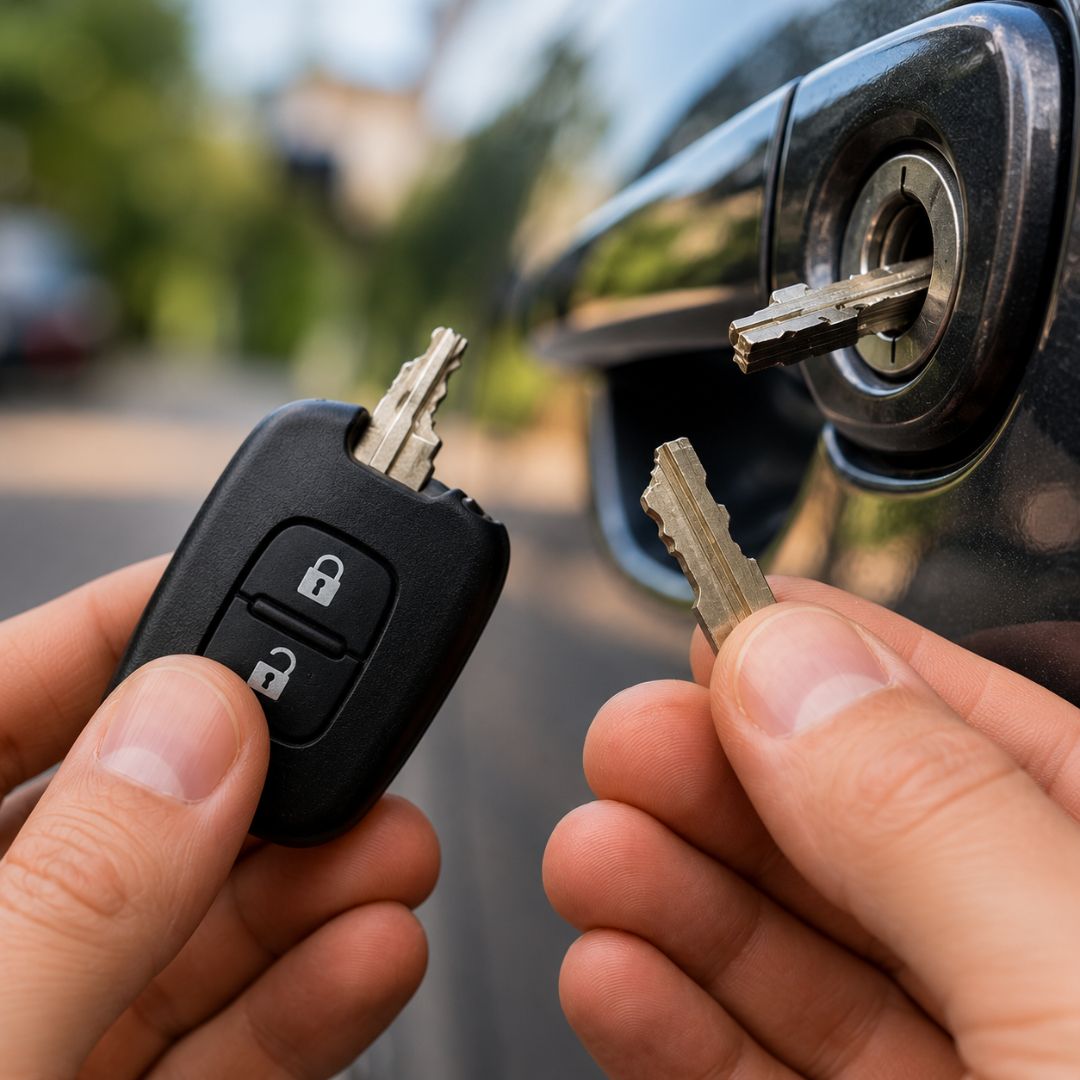
A key not detected warning means the car cannot find an authorised key in the cabin. A flat smart key battery causes most of them. Holding the key against the emergency start position starts the car within a minute.
The warning arrives at the worst possible moment, because it arrives when the car is parked and the driver wants to leave. Nothing looks broken. The key is in your hand, the doors opened, the lights came on, and the engine does nothing.
What follows is the action that starts most of these cars first, then the six things that cause the warning, ranked by how often each one turns out to be the answer.
What does the key not detected warning mean?
A key not detected warning is the car reporting that the aerials inside the cabin called for a key and received no answer they accept.
The system works as a short conversation rather than as a signal pushed at the car. Pressing the start button makes aerials mounted around the cabin send out a low frequency wake signal. A key in range wakes, answers on 433.92 MHz with an encrypted code, and the car checks that code against the keys it has stored. A smart key spends almost its whole life asleep and wakes only when it is called, which is why a key that looks and feels perfectly normal goes unanswered.
That is a different fault from an immobiliser light. There the car found a key, read it, and refused it. Here the car found nothing at all.
What to do the moment the warning appears
Before anything is diagnosed, most of these cars start where they stand. The emergency start position is built into the vehicle for this exact situation rather than being a workaround, and it is printed in the handbook of every keyless car sold in the UK.
Two attempts settle it. If nothing has changed after the second, an emergency auto locksmith reaches the car where it sits, which saves a vehicle that cannot be started from also being recovered.
Where the emergency start position sits
Three positions cover almost every keyless car on a UK road. A marked spot on the steering column, usually a small key symbol moulded into the plastic. A tray, pocket or cup holder in the centre console with the same symbol inside it. Or the start button itself, where the key is pressed flat against the face of the button.
Which of the three applies is decided by the manufacturer rather than by the age of the car, so the handbook is the fastest way to find it. It is worth looking it up once while the car is working, because the glove box is a difficult place to read in the dark.
What happens once the engine starts
The engine keeps running. Keyless systems check for the key when the engine is started and not continuously afterwards, so a car started this way drives normally.
The warning usually stays on the instrument cluster, and that is expected rather than a second fault. The mistake is switching the engine off somewhere with no help nearby, because the next start needs the same trick again and there is no guarantee it works twice.
Why does a car stop detecting the key?
Six causes account for nearly all of these, and they are set out below in the order they turn out to be the answer. The first two are power, the third is the environment the car is parked in, and the last three are faults in the key or in the vehicle. Working down the list in order saves the most time.
A weak battery inside the smart key
The commonest cause by a wide margin. Almost every smart key runs on a 3 volt lithium coin cell, and a cell lasts two to four years in normal use.
What catches people out is the order in which things fail. Detection needs more power than the lock and unlock buttons do, so the car stops finding the key while the buttons still work. A driver whose doors open from the fob reasonably concludes the key is fine. It is not fine, it is halfway through dying, and it stops working altogether a few weeks later.
Cold weather brings the whole thing forward. A marginal cell that manages in September fails on the first frosty morning, which is why these calls cluster in November.
A weak battery in the car
The second power problem, and the one nobody suspects. Below roughly 11.5 volts the aerial and receiver circuits misbehave before the starter motor does, so the car reports a missing key rather than a flat battery.
The supporting signs are easy to read once you know to look for them. Interior lights dimmer than usual, a dashboard that flickers as the button is pressed, wipers that move slowly, and a radio that resets itself. Where two or three of those appear together, the key is almost certainly innocent.
Signal interference around the parked car
The exchange between key and car happens at very low power, which makes it easy to drown out. Multi-storey and underground car parks are the usual places, along with ground close to a transmitter, an airfield or a large industrial site.
Interference also travels in the car with you. A key resting against a phone, sitting on a wireless charging pad, or pressed hard against a second key in the same pocket, all reduce what the aerials hear. Aftermarket wiring run near a cabin aerial does the same.
The test takes seconds. Separate the key from everything else it is touching and try again. If that changes nothing, move the car a few metres, or push it clear of the structure where that is practical.
Physical damage inside the smart key
Smart keys are dropped, sat on, and put through washing machines. The outside of the case says very little about what happened inside, and a key that looks untouched is often the faulty one.
Three internal faults account for most of it. Battery contacts bent or lifted so the cell no longer sits against them, a cracked solder joint on the board, and water that dried out leaving corrosion behind. There is also a quieter one worth knowing about, which is the bitter coating manufacturers now put on coin cells to stop children swallowing them. That coating sits between the cell and the contact and stops the key working while the cell itself is perfectly good. Key fob repairs deal with all four without a new key being needed.
A key that has lost synchronisation
Keys and cars use a rolling code that moves on with every exchange. A key can fall far enough out of step for the car to stop accepting what it sends, and it then has to be reprogrammed rather than repaired.
The tell is simple. Synchronisation is lost by one key at a time, so a spare that works normally while the everyday key does not points here. Both keys failing together points somewhere else entirely.
A fault on the car side
The last group, and the one where the key is not at fault at all. Cabin aerials fail individually, which produces a car that finds the key in one seat and not in another. Receiver and keyless control modules fail outright. The switch behind the start button wears, so the press registers as a half press or not at all.
None of this is diagnosed from the driving seat, and none of it is a do-it-yourself job. What matters at this point is recognising that a new key fixes nothing, because the fault is in the car reading it. Remote car key repair starts by establishing which side of that line the fault sits on.
Has the key failed or the car?
This is the question that decides everything afterwards, and one test answers it.
Try the spare key. Not the emergency blade, the second complete key. Then read the result against these two outcomes.
- The spare starts the car. The fault is in the first key. A cell, a repair or a replacement key solves it, and the car itself needs nothing
- Neither key is detected. The fault is in the car. Two keys do not fail on the same morning, so the aerials, the receiver, the start button or the vehicle battery is the answer
That second outcome is the one worth acting on quickly, because a new key bought to solve it solves nothing. It is also the reason a spare kept in a drawer earns its keep on a single morning. A driver with no spare cannot run this test at all, and has to pay somebody to run it for them.
What the warning says on different dashboards
Manufacturers word this warning differently, which makes it hard to tell whether advice written about one message applies to another. The table sets the common British wordings against what the car is actually reporting.
| Message on the dashboard | What the car is reporting |
|---|---|
| Key not detected | No answer the car accepts reached the cabin aerials |
| No key detected | The same fault, worded differently |
| Key not found | The same fault again, used by several manufacturers |
| Key not in vehicle | A key answered from outside the cabin, often the boot or a door pocket |
| Key not in range | An answer arrived too weak to read, which points at the cell or at interference |
| Smart key system fault | The car has recorded a fault in its own keyless hardware, not in the key |
| The message appears while driving | The key stopped answering after the engine started, and the engine runs until it is switched off |
Only two rows change what happens next. A message naming range points at the cell first. A message naming the system points at the car first, and the spare key test confirms it either way.
Why the warning comes and goes
An intermittent warning is harder to solve than a permanent one, because the car works often enough for the fault to be dismissed and then strands somebody a fortnight later.
Three things behave this way. A cell holding just enough charge, which works warm and fails cold. An aerial connection that moves with temperature or with the car flexing over a kerb. And a location fault, where the car fails in one car park and nowhere else, which is interference rather than a fault at all.
Write down three things every time it happens, because the pattern is the diagnosis. When it happened, where the car was parked, and which key was being used. Three entries usually separate the cold mornings from the one location, and separating those two saves paying for a key that was never the problem.
What not to do while it shows
Five things make this worse, and four of them are common.
- Do not keep pressing the start button. Repeated presses drain the vehicle battery, and a marginal battery is one of the six causes
- Do not switch the engine off once it has started. Drive to somewhere the car can be dealt with first
- Do not force the emergency blade into the ignition. On a keyless car that blade is for the door lock, and forcing it elsewhere turns one bill into two
- Do not fit a cell of the wrong size. A cell that is thinner than the correct one sits loose against the contacts and reproduces the same fault
- Do not ignore it because it cleared on its own. A warning that clears itself is the early stage of the same fault
The third one accounts for a real share of ignition barrel work, and it is entirely avoidable.
How an auto locksmith finds the cause
The sequence matters more than the equipment, because each step rules out a group of causes rather than testing a guess.
The cell comes first, measured under load rather than at rest, because a cell reading close to 3 volts with no load still collapses the moment the key tries to answer. The vehicle battery is measured next, for the same reason and with the same method.
The spare key is then tested against the same aerials, which splits the fault between the key and the car in one move. The keyless module is read for what the car has recorded, which shows an aerial that has been failing intermittently for weeks and gives the pattern the driver could not see. Individual cabin aerials are tested last, because they are only worth testing once the key has been cleared. Where the car turns out to be reading a key and refusing it, the fault belongs with the immobiliser warning light instead.
Three outcomes come out of that sequence. A cell, a key, or a repair to the car. Knowing which one applies before anything is bought is the whole value of running the steps in order.
How to stop the warning coming back
The opposite state, a car that finds its key every single time, comes down to four habits rather than to luck.
Change the cell on a schedule rather than on failure. Every two years, whether or not anything has gone wrong, costs very little and removes the commonest cause outright.
Use the spare occasionally. A spare that has sat in a drawer for six years has a cell as old as the car, so it fails on the morning it is needed to run the one test that matters.
Keep the key away from phones and charging pads. The same pocket is enough, and a separate pocket costs nothing.
Act on the first missed unlock rather than the twentieth. Detection weakens gradually, so the first morning the doors need two presses is the warning. Everything after that is the system telling you the same thing more loudly.

 07932805727